F&F Surface Group · Flooring Guide
Herringbone and Chevron Hardwood Floors: Pattern, Cost and What to Ask
Updated September 21, 2026 · 8 min read
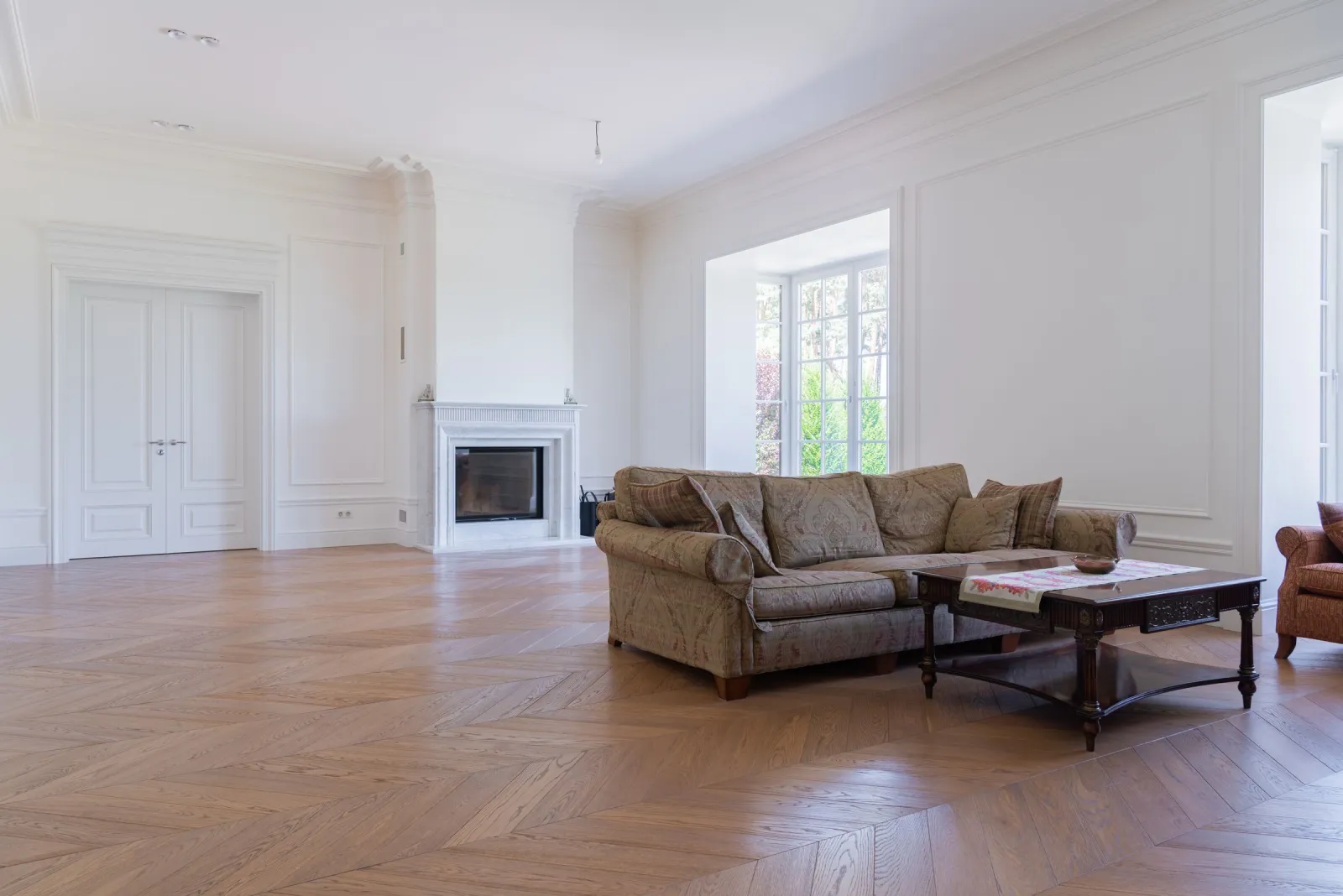
Patterned wood floors are not a trend. Herringbone has been laid in European houses for centuries, and it has been underfoot in the grander homes of Kalorama, Cleveland Park and Chevy Chase since they were built. What has changed is that more homeowners across the DMV are asking for it in new work: a foyer, a dining room, sometimes a whole main level.
It is one of the most rewarding floors to have and one of the least forgiving to install. Here is how the two main patterns differ, what drives the cost, and the decisions that determine whether the finished floor looks intentional.
Herringbone and chevron are not the same floor
Herringbone is made from plain rectangular boards. Each board's end butts against the side of its neighbor at ninety degrees, so the pattern steps across the room in a staggered zigzag. It reads as woven and slightly busy, in a good way, and it is the more traditional of the two.
Chevron boards have both ends cut on an angle, commonly 45 or 60 degrees. They meet point to point, forming continuous V shapes with a crisp straight seam down the middle of each row. It reads as cleaner and more directional, like arrows running the length of the room. A steeper angle gives a longer, more elongated V.
The practical difference: herringbone can be made from ordinary flooring cut to consistent lengths. Chevron requires every end to be milled to exactly the same angle and length, because any error repeats down the whole row and shows along that center line.
There are other parquet patterns, such as basket weave, brick bond and Versailles panels, but these two account for nearly every patterned floor we are asked about.
Where a pattern earns its place
A patterned floor draws the eye, so it works best where there is floor to look at.
- Foyers and entry halls. The classic location. A modest area, seen by everyone, with little furniture covering it.
- Dining rooms and libraries. Defined rooms with doorways that give the pattern a natural start and stop.
- Hallways. Chevron in particular pulls the eye down a long corridor.
- A full main level. Striking in an open plan, but it is a serious commitment in labor and it needs a layout that works from every sight line, not just one.
Where it struggles is a small room full of furniture, where you pay for a pattern and then cover most of it, and a room chopped up by many jogs and angles, where the cuts at the walls start to compete with the pattern itself.
A common approach in DMV homes is to pattern one or two rooms and run straight boards of the same species and finish everywhere else. Sanded and finished together, it reads as one floor with a feature, not two floors.
Scale: board size makes or breaks it
The width and length of the individual boards set the scale of the pattern, and the scale has to suit the room. Small boards in a large room look fussy; large boards in a small room show so few repeats that the pattern never establishes itself. As a rule of thumb, you want to see the zigzag repeat several times across the narrow dimension of the room.
Board length also has to be an exact multiple of board width for a true herringbone to close up properly. That is a milling detail rather than a design one, but it is the reason patterned floors are ordered as a specific product or cut to a specific size, not improvised from whatever plank is on hand.
Borders and direction
A border is a frame of straight boards around the room, sometimes with a contrasting feature strip, with the pattern laid inside it. Borders are traditional in older DC and Chevy Chase houses, and they solve a real problem: walls are never perfectly square, and a border absorbs that so the pattern inside can be. They also add layout and labor time.
Direction matters more than people expect. The points of the pattern usually run along the long axis of the room or toward its focal point: a fireplace, a bay window, the main doorway. The centerline is set from that feature rather than from a wall, so the pattern lands symmetrically where the eye goes first.
Why it costs more than a straight floor
Expect a patterned floor to cost noticeably more than the same wood laid straight. The reasons are all practical:
- Layout. A straight floor starts from one wall. A patterned floor starts from a snapped centerline and working lines, and the first few rows are set slowly, because every board after them inherits any error.
- Piece count. The room is covered in short boards, each placed, glued and fastened individually. There are simply many more pieces per square foot.
- Waste. Every board that meets a wall or border is cut on an angle, and the offcut is rarely usable. More material is ordered than for a straight lay, which our guide to hardwood installation costs touches on.
- Subfloor preparation. Short boards follow every dip and hump, so the subfloor has to be flatter than a long plank would require.
- Finishing. Sanding a two-direction grain takes more passes and more care.
Our installation process guide covers the stages every hardwood job shares. A patterned floor follows the same sequence, with the layout stage expanded considerably.
Solid or engineered
Both are legitimate. Solid is the traditional material, typically glued and nailed over a wood subfloor, and it can be sanded many times over its life. Engineered is the usual answer over a concrete slab, in a condo or over radiant heat, and it is sold in ready-made herringbone and chevron formats with left- and right-handed boards.
Short boards have an advantage here: a short piece of wood moves less along its length than a long plank, so patterned floors tend to be stable. They still respond to DMV humidity across their width like any hardwood, and they still need acclimating before installation. For the full comparison, read engineered vs. solid hardwood.
Species, color and sheen
White oak is the most common choice for new patterned floors: it is stable, takes stain evenly and has a calm grain that lets the pattern do the talking. Walnut is the classic formal option. Red oak works well and is what many original DMV herringbone floors are made of. Our species guide compares them.
One thing to see in person before you choose a color: because the boards run in two directions, light reflects off them differently, so half the pattern always looks a shade lighter than the other half, and it swaps as you walk around the room. That shimmer is the appeal of the floor. A natural or mid-tone stain shows it best; a very dark stain flattens it. A matte or satin sheen keeps the effect subtle, while high gloss exaggerates it and shows every scratch.
Refinishing an existing patterned floor
If your house already has herringbone or parquet, it can almost certainly be refinished, and it is well worth doing. It cannot be treated like a strip floor, though. There is no single grain direction to follow, so the floor is sanded on an angle to the pattern and then finished with multi-directional sanders that remove the cross-grain scratches a drum sander would leave. Stain makes any remaining scratch obvious, so the sanding has to be right before color goes on.
Older patterned floors also tend to have loose blocks where the original adhesive or nails have let go. Those are re-secured before sanding, and missing pieces are cut to match. Our guides to the sanding process and refinishing floors in older DC houses cover what else to expect.
Questions to ask before hiring anyone
- Have you installed this specific pattern before, and can I see photographs of it?
- Where will the centerline run, and what feature is it set from?
- Will there be a border, and how will doorways and transitions to straight flooring be handled?
- How flat does my subfloor need to be, and what will you do if it is not?
- How much extra material are you ordering for waste, and will a box be left with me for future repairs?
A contractor who has done the work will answer all five without hesitating. Our guide to choosing a flooring company has the broader checklist.
Frequently asked questions
What is the difference between herringbone and chevron flooring?
The cut at the end of each board. Herringbone uses rectangular boards with square ends, laid so the end of one meets the side of the next, which produces a staggered, broken zigzag. Chevron boards have their ends cut at an angle, commonly 45 or 60 degrees, so they meet point to point in a continuous V with a straight line running down the center of each row.
Does a herringbone floor cost more than a straight-lay floor?
Yes, and mostly in labor. Every board is a short piece that has to be placed precisely, the layout takes far longer to set up, and cuts at the walls produce more waste, so more material is ordered. Chevron generally costs more again because the angled ends have to be milled accurately or bought pre-cut.
Can a herringbone floor be sanded and refinished?
Yes, provided it is solid wood or engineered with a wear layer thick enough to sand. The technique is different from a straight floor. Because the grain runs in two directions, the floor cannot simply be sanded with the grain, so it is sanded on an angle to the pattern and finished with multi-directional equipment that does not leave cross-grain scratches.
Is herringbone a good idea in a small room?
It can be, if the board size is scaled to the room. Short, narrow boards keep the pattern in proportion in a foyer, hallway or powder-room vestibule. Long, wide boards in a small room show only a few repeats of the pattern and tend to look busy rather than deliberate.
Should a patterned floor be solid or engineered hardwood?
Either works. Solid is the traditional choice over a wood subfloor, nailed and glued, and can be refinished many times. Engineered is the usual answer over concrete, in condos and over radiant heat, where it is glued down, and it is widely available in pre-made herringbone and chevron formats. The subfloor and the building usually make the decision.
Thinking about a patterned floor? Request a free in-home estimate. We will measure the room, talk through board size, direction and borders against your actual sight lines, and give you a written price for the pattern alongside a straight lay so you can see the difference — see also our solid hardwood and engineered hardwood pages.
Keep exploring
- → See our hardwood flooring installation
- → Hardwood flooring in Chevy Chase, MD
- → Hardwood flooring in McLean, VA
- → Hardwood flooring in Washington, DC
- → What Hardwood Floor Installation Actually Costs in the DMV
- → Refinishing Floors in a Pre-War Rowhouse or Colonial
- → Engineered vs. Solid Hardwood: Which Belongs in Your DMV Home?